
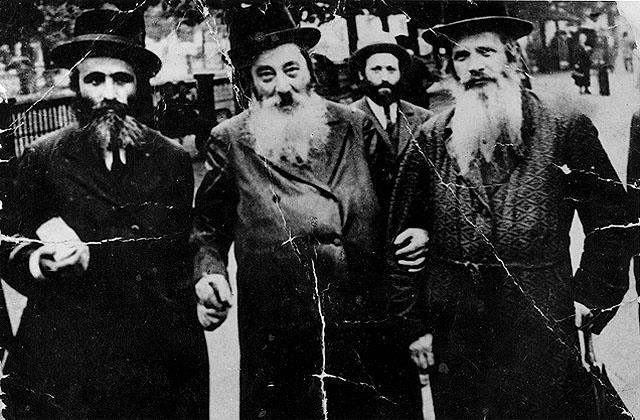
The Jews in Vijnița during the Holocaust
The deportation of Jews from Vijnița
Historical information indicates the existence of a Jewish community in the middle of the 18th century. In 1880, 4,379 Jews lived in Vijnița, and in 1910 their number was 4,317, which meant 91% and 82% of the total population, respectively. For the interwar period, the data shows a demographic decline. Thus, in 1930, the number of Jews was 2,686. For the years 1939-1940, it is estimated that between 5,000 and 7,000 Jews lived in the locality. Their occupations were in the fields of trade, crafts and agriculture. In Vijnița, there was a synagogue and eight houses of prayer.
Persecutions
The establishment of the Goga - Cuza government, December 29th, 1937 - February 10th, 1938, meant the adoption of Jewish legislation, applicable throughout the country, including Vijnița, then part of Romania. Jewish civil servants were fired, and Jewish artists were barred from practicing the profession. At the same time, mixed marriages were banned.
The territorial surrenders in the summer of 1940 and the entry of several Romanian localities under Soviet administration, including Vijnița, also meant taking measures against the Jews. Zionist organizations were banned, and on June 13th, 1941, 13 Jewish families were deported to Siberia.
After the occupation of Vijnița by German and Romanian troops on July 5th, 1941, the Romanian authorities, under whose jurisdiction the town re-entered, granted the locals a 24-hour permit, during which time they could do whatever they wanted with their fellow Jews. At the same time, units of the Romanian army proceeded to search the houses owned by Jews under the pretext of searching for weapons. All this culminated in the killing of 21 Jews in the city and another 14 in a forest on the outskirts of the town. As a justification for these crimes, the behaviour of the Jews towards the Romanian army during the withdrawal from Bukovina, in June 1940, was advanced.
Marius Mircu, the author of one of the first works on the tragedy of the Jews from Bukovina, left us the following fragment about the crimes that took place in July 1941 in Vijnița: “In Vijnița (Storojineț County), too, the entry of Romanian troops was celebrated through a pogrom, organized by the authorities. […]. The children had also learned that for 24 hours one could and should do anything with the Jews. In Vijnița there were many Jews, too, they were 90% of the entire population. The soldiers, led by local peasants, entered every Jewish house. They searched the Jews to the skin. Where they found something (money, jewellery), they killed because they found it, where they found nothing, they killed because they didn’t find it. Some Jews were killed in the city, others (14) were taken to the forest of Vijnița Nouă and shot there.”
After the end of these assassinations, at the end of July 1941, a temporary camp was set up in Vijnița. But it was only a first step in deporting the Jews. Several deportations took place from Vijnița. In August 1941, 1,820 Jews were initially deported to Edinet, and then to Transnistria. Another 2,800 were deported on October 12th of the same year. It is estimated that of the latter, only about 400 survived.
While waiting at the checkpoints, the deportees were deprived of their belongings and their identity documents were destroyed. During the marches, Jews fell victim to murder and rape. The Jews from Vijnița arrived in several ghettos, including those in Moghilev, Berezvoca or Mostovoi, where most died due to the conditions in which they were kept.
Sources
Ovidiu Creangă, Vijinița, in Geoffrey P. Megargee (general editor), Encyclopedia of Camps and Ghettos 1933-1945, Bloomington and Indianapolis: Indiana University Press, 2018, pp. 820-821.
Daniel Hrenciuc, Vijnița, accessible online at http://www.inshr-ew.ro/wp-content/uploads/2018/01/Vijnita.pdf
Marius Mircu, Pogromurile din Bucovina și Dorohoi [The Pogroms in Bukovina and Dorohoi], București, Editura Glob, 1945, p. 44.