
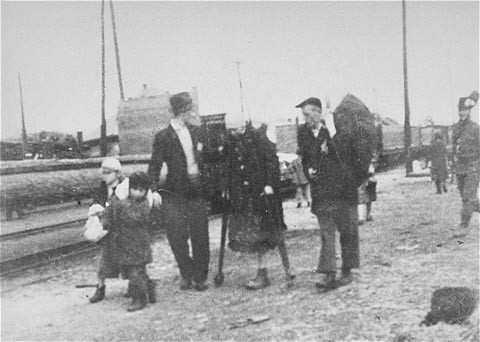
A street in the Sighet ghetto after deportation.
https://encyclopedia.ushmm.org/images/large/8fb0d1e9-2927-45bd-8ebe-d276e226b394.jpg.pagespeed.ce.0GtzA16DNT.jpg
https://encyclopedia.ushmm.org/images/large/8fb0d1e9-2927-45bd-8ebe-d276e226b394.jpg.pagespeed.ce.0GtzA16DNT.jpg
The Jews in Sighet during the Holocaust
The deportation of Jews from Sighet
The Jews settled in Sighet at the beginning of the 18th century. In the following century, as a result of the settlement of Jews in Poland, their number increased from 142 in 1785 to 3,380 in 1880. In 1910, 7,981 Jews lived in Sighet, and in 1930 the Jewish population was of 10,144 people. In 1807, the first synagogue was built.
Persecutions
The fate of the Jews in Sighet was similar to that of the Jews in other cities administered by the Hungarian government. Initially, the repressive measures targeted the so-called stateless Jews, i.e. those who were strangers to the city. In the summer of 1941, several hundred such Jews were deported to Kameaneț, Ukraine, where they were killed by Nazi troops. According to existing information, only one person from Sighet survived the massacres. Back in town, they told what had happened. Their accounts were unbelievable. Beginning in 1941, military-aged Jews were mobilized for forced labour, being sent to Hungary and Ukraine. Those who arrived in Ukraine died.
Unlike the other cities under Hungarian administration in 1940, in Sighet the measures to prepare for deportation began almost two weeks earlier. On April 1st, 1944, Jews were forbidden to leave their homes between 6:00 pm and 6:00 am. At the same time, Jewish-owned shops were marked with the “yellow star” badge.
At the same time, on April 20th, 1944, Jews in the city were evacuated from their homes and interned in a ghetto, which included four city streets, generally inhabited by poor Jews. The large number of inmates made the ghetto extremely crowded. About 20 people lived in each room in the ghetto. The security was provided by the Sighet police and the Hungarian gendarmerie. At the same time, there was another ghetto in the city, called the “small ghetto”, in which Jews from other localities of the county were kept. The total number of Jews in the two ghettos in Sighet was about 13,000.
Among Jews, 140 intellectuals and community leaders were held separately as hostages in one of the city’s synagogues without food and water. Complementary to the internment of the Jews in the ghetto, their valuables were also confiscated. Also, during the ghetto’s existence, Jews were questioned and investigated about the assets they allegedly hid.
One survivor described life in the ghetto as “unbearable”; the main cause being the lack of food. In order to support the ghettoized, the community organized “two cooperatives and two public kitchens, respectively, where the entire ghetto and those people who had no food at home were fed." The deportation of the Jews began on May 16th, 1944. Between that date and May 22nd, 1944, four transports took place. A total of 12,749 people were deported to Auschwitz from Sighet.
Elie Wiesel described how the deportation of Jews from Sighet took place, leaving us the following testimony:
"Saturday, the day of rest, was the day chosen for our expulsion. [...]. The convoy headed for the great synagogue. The city looked deserted. But behind the shutters, our friends from yesterday were no doubt waiting for the moment when they could rob everything we had in the houses. [...].
The next morning, we left for the train station, where a train with animal wagons was waiting for us. The Hungarian gendarmes put us on the train, eighty people in a car. We were given a few loaves of bread and a few buckets of water. They checked the bars on the windows to make sure. The wagons were sealed. One person had been assigned to each car: if someone ran away, the person in charge would be shot. Two smiling Gestapo officers were walking on the platform; all in all, everything had gone well.
A long hiss pierced the air. The wheels began to creak. We set off.”
After 1945, in Sighet, some of the surviving Jews returned. In 1947, their number was 2,300, and in 1956 1,381 people. During the communist years, most left Romania.
Sources
Kinga Frojimovics, Sighet, in Randolph Braham, Zoltan Tibori Szabo, Enciclopedia geografică a Holocaustului din Transilvania de Nord [Geographical Encyclopaedia of the Holocaust in Northern Transylvania,], Chișinău, Cartier/Editura Institutului Național pentru Studierea Holocaustului din România „Elie Wiesel”, 2019, pp. 229-233.
Randolph Braham, Sighet, in Israel Gutman (editor), Encyclopaedia of the Holocaust, vol. IV, New York/London, Macmillan Publishing Company/Collier Macmillan Publishers, 1990, p. 1350.
Elie Wiesel, Noaptea [The Night], București, Corint, 2021, pp. 53-54.
Oliver Lustig, Procesul ghetourilor din nordul Transilvaniei - Ghetoul din Sighet. Mărturii [The Process of Ghettos in Northern Transylvania – The Sighet Ghetto. Testimonies], vol. II, București, Editura Aervh, 2007, accessible online at http://www.survivors-romania.org/text_doc/sighet.htm
Michael K. Silber, Sighet, accessible online at