
The Jews in Fălticeni during the Holocaust
July 1941
The community of Jews in Fălticeni
The oldest documentary evidence attests to the presence of Jews on the current territory of Fălticeni since the 18th century, being mentioned the existence of a community between 1772 and 1774. In 1781, the Jews founded the first synagogue. In the same year, they were granted the right to build their own homes. The privileges enjoyed by the local Jews, such as practicing trade or raising cattle for trade, made Fălticeni an attractive place for Jews from Bessarabia, Bukovina, and Galicia. With their settlement here, the number of Jews gradually increased. In 1803, 848 Jews lived in the city, and in 1832, 1,519. Beginning in 1859, their number increased to 5,765. However, it diminished in the following decades. In 1930, 4,216 Jews lived in Fălticeni, which represented 29% of the city’s inhabitants. With the establishment of the Jews in Fălticeni, they built synagogues, a ritual bath, a hospital, an asylum for the elderly, and public schools for boys and girls. Following the participation in the War of Independence in 1877, 42 Jews obtained Romanian citizenship.
Persecutions
Jews have been victims of persecution and violence as early as the 19th century. In 1821, some of the community leaders were killed by Greek revolutionaries because they could not pay the amount they demanded, probably demanded for the cause of the revolution. In 1916, although the Jews were not citizens of a state with which Romania was at war, the Jews from Fălticeni, along with those from Iași, Dorohoi, Bacău, were arrested by the Romanian authorities and taken to the police stations. Existing data mentions that between 11,000 and 12,000 Jews were detained during that period, of which about 9,000 in January 1917. During the detention, they were beaten and robbed.
During the legionary rule, the Jews from Fălticeni were brought to the “Green House”, the headquarters of the Legionary Movement, where they were beaten and assaulted. The legionaries demanded that the Jews pay a fee for their release.
With the start of the war, 1,000 Jews from Fălticeni were sent to forced labour in Bessarabia. Jewish teenagers aged 16-17 were also used for forced labour in the city. Because some of them were absent, Fălticeni City Hall proposed their punishment by applying “25 blows each by C.T”, which was the standard punishment for being absent from work.
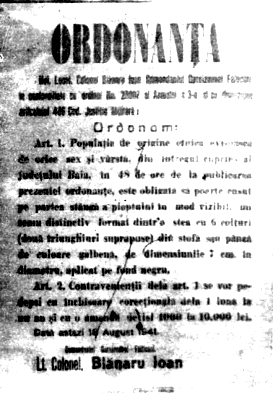
At the same time, the Jews of the city were obliged to wear the “yellow star”, since July 4th, 1941, when messages appeared on the walls of Bacău, Galați, Botoșani, Huși, Fălticeni asking for the wearing of this distinctive sign. At the same time, due to the economic measures taken against them, a large part of the Jews reached the poverty line, being put in the situation of finding it difficult to survive. In 1947, about 4,700 Jews had returned to the city. During the communist period, most emigrated to Israel.
Sources
Anca Filipovici, Fălticeni, accessible online at http://www.inshr-ew.ro/wp-content/uploads/2018/01/Falticeni.pdf
***, Fălticeni, accessible online at http://www.inshr-ew.ro/wp-content/uploads/2018/01/Falticeni.pdf
Ana Bărbulescu, Alexandru Florian (editors), Holocaustul din România. Regimul de muncă obligatorie impus evreilor. Documente [The Holocaust in Romania. Compulsory labour regime imposed on Jews. Documents,], Iași, Polirom/Editura Institutului Național pentru Studierea Holocaustului din România „Elie Wiesel”, 2013, p. 399.
Comisia Internațională pentru Studierea Holocaustului în România [International Commission for the Study of the Holocaust in Romania], Raport Final [Final Report], Iași, Polirom, 2004, pp. 129-130, 202.
Radu Ioanid, Holocaustul în România [The Holocaust in Romania], ediția a II-a, București, Editura Hasefer, 2006, pp. 30.