The Jews in Buzău during the Holocaust
September 1940
In 1907, the year of the peasant uprising, the Jewish and Romanian shops in the city center were vandalized by the rebels. They also destroyed the Jewish school and the synagogue of craftsmen in Calea Dobrogea.
Shortly after the proclamation of the legionary national state in September 1940, the legionaries began a campaign to persecute the Jews. Romanian shoppers were barred from entering Jewish shops, and their owners were forced to display placards and inscriptions with anti-Semitic messages. In front of the shops, sentries were placed to prevent potential buyers from entering. Those who intended to buy from a Jewish store were threatened with beating. At the same time, Jews trying to enter Jewish shops were arrested and taken to the police station, where they were beaten and investigated. One such case was that of Zacharias Solomon, former president of the Community.
In the same month, the hunt for communists among young Jews began. Thus, in September 1940, a group of young Zionists, aged between 16 and 20, were arrested and then beaten to admit to being communists. A memorandum from the Federation of Jewish Communities in Romania, dated December 30, 1940, states that adolescents and young people in Buzau arrested on suspicion of being communists were denied the right to a fair trial, and lawyers were forbidden to contact those arrested.
The attacks of the legionaries were directed both against the Jews who prayed in the synagogues and against the Jewish cemeteries. In September 1940, Jews praying in a synagogue were robbed by a group of legionnaires and held hostage for an entire night. A few months later, in November 1940, one of the local Jewish cemeteries was destroyed by members of the legionary movement, and the tombstones were stolen by a local priest, apparently for his own church.
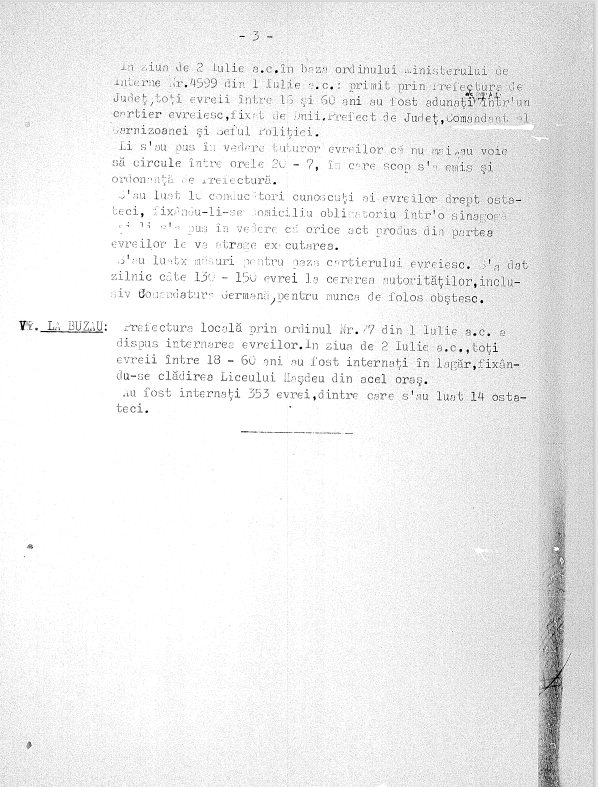
According to the order given by Antonescu, in June 1941, the Jews from the county were brought to Buzău. The following month, the men, aged between 18 and 60, were picked up and interned in a camp set up inside the Hașdeu high school. In that makeshift camp, there were 353 Jews. By an order sent to several police departments, General Ion Antonescu also called for measures to be taken to ban the movement of Jews on the streets in cities with a “large Jewish population” between 18.00 and until the next morning, at 7.00. At the same time, the Jews were asked to be “grouped in neighborhoods and gathered in certain larger buildings, under guard, so that any attempt at disturbance could be immediately supervised and sanctioned”.
In order to prevent their possible actions against the authorities, Ion Antonescu also ordered the taking of hostages among the interned Jews. The hostages were to be held accountable for the behavior of the other Jews. They were told that they would answer with their own lives if the other Jews had hostile manifestations. In fact, the order of 7th July 1941 provided for the immediate shooting of hostages in the event of acts of rebellion or terrorism: “at the same time, hostages will be taken from among known Jewish leaders, communists, and communist regionals who will be shot as soon as an act of rebellion or terrorism occurs”. The hostages, 14 in number, were kept separate from the rest of the interned Jews, being imprisoned in the Sebastian Eskenazy house in Voicescu street no. 7. Rabbi Simion Bercovici, some of the richest Jewish merchants in the city, and two singers were taken hostage.
Beginning in August 1941, the selection of interned Jews for sending them to forced labour began. 250 Jews were transported to Făurei, where they were used in works to dam the river Buzău. According to the available information, the camp at Hașdeu High School was disbanded on March 30th, 1942.
Women between the ages of 18 and 40 were not exempt from forced labour neither, as they were used for various jobs by local authorities or the army.
It is important to note that in 1944, 680 orphans from Transnistria found refuge in Buzău, where they were cared for by Jewish families or by the institution Eforia Copilului [The Child’s Guardianship], created to help orphans. Later, they arrived in Palestine. During the communist period, the number of Buzău Jews decreased steadily as a result of emigration to Israel.
Sources
Matatias Carp, The Black Book. The Sufferings of the Jews from Romania 1940-1944. The Legionary Movement and the Rebellion, vol. I, București, The Socec Publishing House, 1946, passim.
Marius Cazan, Buzău, accessible online at http://www.inshr-ew.ro/wp-content/uploads/2018/01/Buzau-revazut-ND.pdf
Știri din vremea războiului. Lagărul de la Liceul „B. P. Hasdeu” (iulie 1941-martie 1942), [Wartime news. The camp at the High School „B. P. Hașdeu” (July 1941-March 1942),] accessible online at https://www.muzeubuzau.ro/stiri-din-vremea-razboiului/
George Ioan Lahovari (coordonator), Marele Dicționar Geografic al României [The Great Geographical Dictionary of Romania], vol. II, București, Stabilimentul Grafic J. V. Socecu, 1899, p. 121.
Eliyahu Feldman, Theodor Lavi, Buzău, accessible online at https://www.jewishvirtuallibrary.org/buzau