
The Jews in Buhuși during the Holocaust
July 1941
In Buhuși, Jews have been victims of anti-Semitic incidents since the interwar period. In 1929, instigating leaflets were distributed in the city, and in 1937 they were prevented from going to the polls.
The situation of the Jews in Buhuși worsened with the entry into force of racial laws in the late 1930s, and those who worked in the cloth factory were fired, being deprived of the material resources necessary for daily life. Leon Kupferberg, one of the factory’s directors, helped the former employees financially.
After the legionaries came to power in September 1940, the measures taken against them took the form of acts of harassment. Held under constant psychic terror, the Jews were periodically taken to the police or town hall, where they were beaten and tortured. The beatings also had an economic purpose. Using such methods, the aggressors actually sought to persuade them to cede their properties and businesses. Illegal and unannounced searches became a constant in Buhuși during the period.
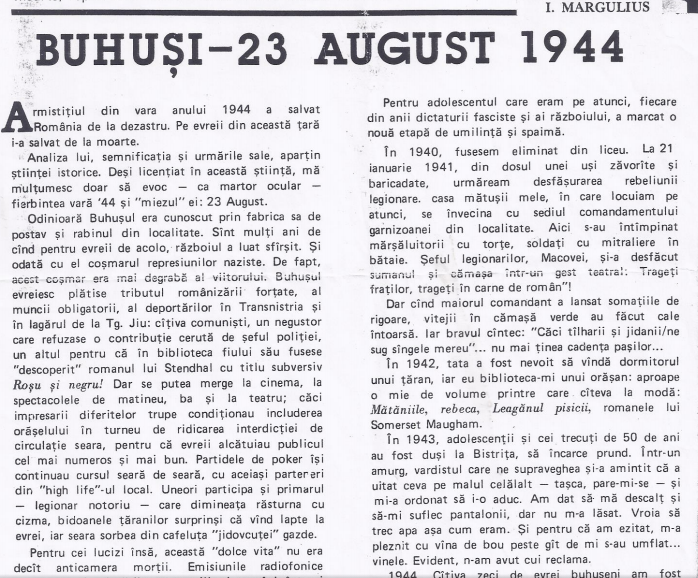
Existing information shows that in November 1940 the legionaries carried out acts of systematic terror in several cities, including Buhuși. The treatments applied to the Jews were described as unprecedented violence. Under the threat of weapons, the Jews were beaten and then forced to give their money to the legionaries and even pay an individual protection fee. Under those conditions, in order to defend their community and protect it from other violence, the leaders of the Jews from Buhuși agreed to pay the legionaries a general protection fee. During the war, city officials banned Romanians from selling products to Jews. The former journalist, I. Margulies, recalled in an autobiographical text the way in which the legionary mayor behaved with the peasants who sold milk to the Jews. Every morning, he “overturned with his boot the cans of the peasants caught selling milk to the Jews”.
Just like in other cities in Romania at the time, the Romanian government ordered measures that turn terrorism into a state policy. Thus, under the pretext of preventing unrest, more than a hundred Jewish workers at the city’s cloth factory were taken hostage in July 1941. After being held in prison for several months, during which time they did not know what fate awaited them, they were sent to forced labour in Piatra Neamț in August 1941, along with all Jewish men between the ages of 20 and 60. In 1943, teenagers and those over the age of 50 were sent to forced labour in Bistrița and made to load gravel, only so that the following year more Jews could be transported to the commune of Români. Here, they were used for “work necessary for the frontline”, such as “weeding on the side of a nearby road”. Also during the war years, the gendarmes sent the Jews from Buhuși to work for the notables of the city, being used for various domestic tasks. Remuneration for the work of the Jews was collected by the gendarmes.
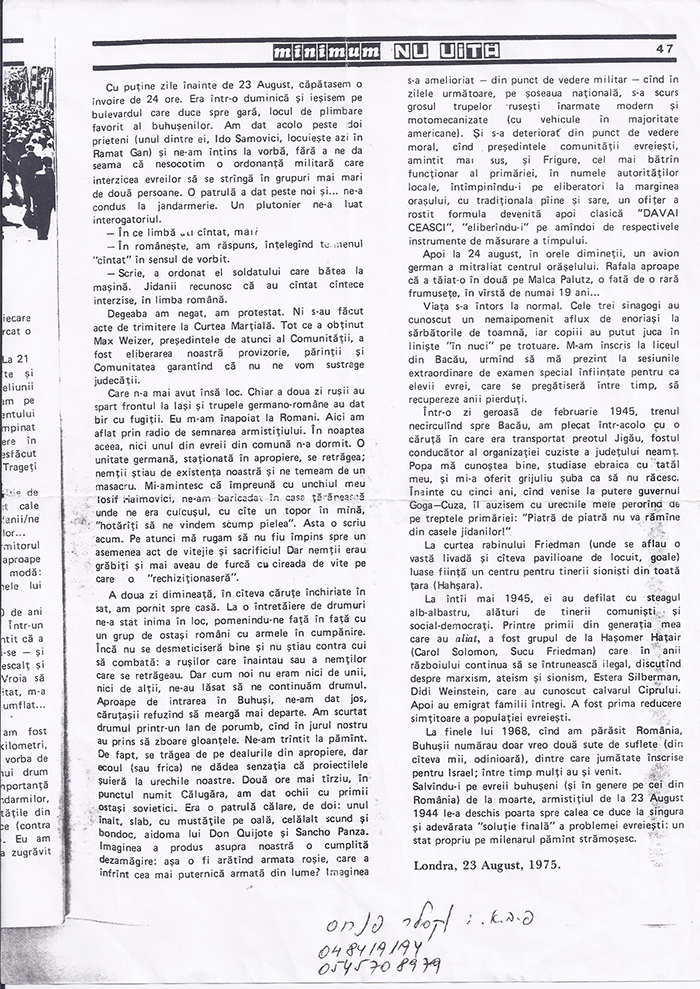
Also, 266 Jews, probably suspected of communist sympathies, according to the belief among the representatives of the Romanian authorities, were interned in the political internment camp in Târgu Jiu. I. Margulies also confesses in the same autobiographical text that, at the time of the declaration of the armistice, no Jew from Buhuși slept because of being horrified. A German unit was retreating nearby. Everyone feared that a massacre might follow. At the same time, they were determined to fight for their lives. Some of them armed themselves with axes, waiting for the Germans to come to the city.
“[…] I found out on the radio about the signing of the armistice. That night, none of the Jews in the commune slept. A German unit, stationed nearby, was retreating; the Germans knew of our existence and we feared a massacre. I remember that together with my uncle Iosif Hainovici, we barricaded ourselves in the peasant house where our bed was, with an ax in our hand, <<determined to sell our skin dearly >>.”
After the end of the war, the Jews from Buhuși returned to their hometown. In time, however, they emigrated to Israel. Thus, no Jews have lived in the city after 1990.
Sources
Marius Cazan, Buhuși, accessible online at http://www.inshr-ew.ro/wp-content/uploads/2018/01/Buhusi-revazut-ND.pdf
Lucian-Zeev Herșcovici, Buhuși, accessible online at https://yivoencyclopedia.org/article.aspx/Buhusi
Matatias Carp, The Black Book. The Sufferings of the Jews from Romania 1940-1944. The Legionary Movement and the Rebellion, vol. I, București, The Socec Publishing House, 1946, passim.
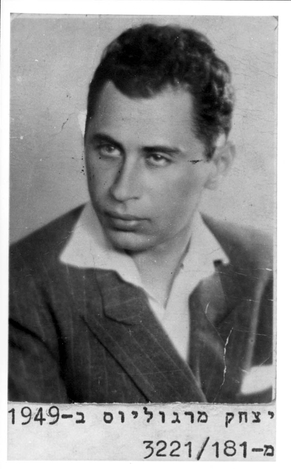
I. Margulius, Buhuși - 23 august 1944, accessible online at https://www.buhusi.net/fragment-din-cotidianul-buhusean-din-perioada-celui-de-al-doilea-razboi-mondial-prin-ochii-unui-localnic-evreu/
Marica Lupan, O fereastră către Buhușiul anilor 1930-1940 [A Window to Buhuși from 1930-1940], accessible online at https://www.buhusi.net/buhusi-oraselul-neuitat-de-lume/