
The synagogue in Alba-Iulia at the begining of XX century
http://memoriaurbis.apulum.ro/bundles/app/images/stories/65_01.jpg
http://memoriaurbis.apulum.ro/bundles/app/images/stories/65_01.jpg
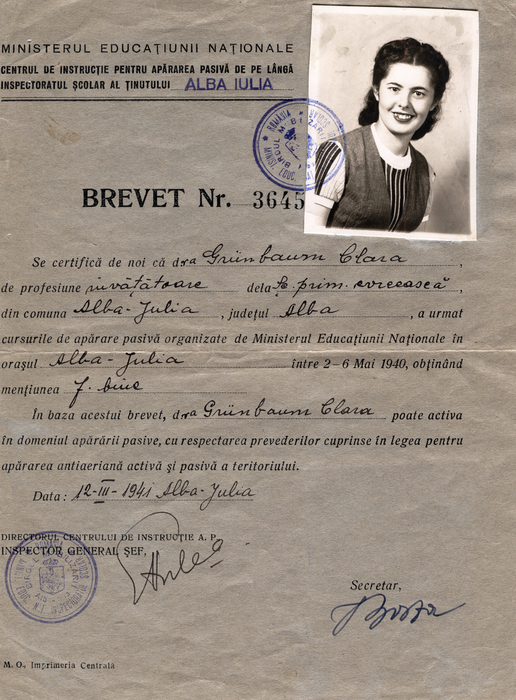
The Jews in Alba Iulia during the Holocaust
June 1941
The History of Jews in Alba-Iulia
The presence of Jews in Alba Iulia is attested as early as the end of the 16th century when there was a rabbinical court in the city. They were descendants of the Jews expelled from Spain. Looked upon with suspicion by the locals and perceived as spies by the Turks, the Jews were persecuted and harassed. Some of them were even hanged by order of Prince Sigismund Báthory (1572-1581). Their situation improved in the next century after Prince Gabriel Bethlen granted them trade privileges, religious freedom, and the right to wear their own ethnic clothing. He also repealed those laws that required Jews to “wear distinctive signs that showed their origin.”
From 1653, the Jews were allowed to settle in the city of Alba Iulia as cottars (jeleri – in Romanian). The cottars were in those days landless peasants who earned their living by working on the nobility’s estates but were not legally serfs. A series of measures aimed the Germanization of the Jews. From 1787, according to the order of Emperor Joseph II, the Jews of Alba Iulia were forced to take their name and surname of German origin. At the same time, the practice of worship was allowed only in private, being one of the rare occasions when they could use their own language.
Until the middle of the 19th century, the Jewish community in Alba Iulia enjoyed precedence among the other communities, being also involved in the movement for obtaining civil rights for the Jews of Transylvania. As a result of those efforts, Jews were granted “permission to settle in the large cities, except for mining cities, where Jews were forced to adopt stable surnames and draw up civil registers (1840); then, the recognition of the equal justification of the Israelites with Christians (1867) and of the equality of the Jewish religion with Christian denominations (1895)”.
Once they settled in this city, the Jews built their own cultural, social, and support buildings. For example, in 1883 the Spanish Synagogue was opened. The favourite occupation of the Jews of Alba Iulia was in the field of trade, engaging in the trade of goods in Poland, Turkey, and Vienna. Starting with the 19th century, the Jews were also involved in the industry, contributing to the construction of the first railway in Transylvania, 1866-1868, between the cities of Arad - Alba Iulia - Teiuș. In the following decades, they also participated in the creation of industrial establishments, such as the “Flour and Pearl Barley Mill” of the brothers Andor and Filip Glück in 1894, the grain alcohol factory of the Adolf Jonas family, the first of its kind in the city.
Over the centuries, the number of Jews increased. The existing data mention that in 1698 there were about 70 Jews in the city so that in the years 1784-1787 their number reached 150, i.e. 3.14% of the city’s population, 735 in 1850, 1,221 in 1870, 1,647 in 1910. In the interwar period, the number of Jews registered a slight demographic decline. In 1930, it was 1,558, i.e. 12.6% of the total population.
Persecutions
With the increase in the number of Jews, the first incidents and accusations appeared. The Jews were attributed by the community in which they lived the role of the “scapegoat” for most of the negative events and deeds occurring in the city life. In 1846, the Jewish community was accused of stealing from churches. In the same year, in the context of the disappearance of a child, it was accused of committing a ritual murder. The accusation did not go unnoticed by the Jews of Alba Iulia: several members of the community were physically assaulted, and their belongings vandalized. Only the discovery of the unharmed child in his home calmed the anger of the majority community.
In Greater Romania, with the emergence of the Legionary movement and the strengthening of extreme right-wing beliefs, attacks on Jews intensified. In some cases, they have taken extreme forms. For example, in 1938, a group of legionary students planted a bomb in the old synagogue and after the explosion, the building was partially destroyed.
Two years after that event, the surrender of Bessarabia and Northern Bukovina once again gave the Jews the unfortunate role of “scapegoat”. As throughout the interwar period, the Romanian authorities maintained and fuelled the idea that the Jews were communists, they were accused of Bolshevism and many of them were physically assaulted. The trains they were traveling on were stopped, and the Jews were thrown out from the train.
The measures taken against them increased in intensity after the proclamation of the national-legionary state. At the level of the whole country, it was found during those days, but especially during the Second World War, the practice of taking hostages among the Jews. The leaders of the Jewish communities were targeted by this measure. In Alba-Iulia, Traian Hesker, a legionary commissioner who had received an apprenticeship in Nazi Germany, arrested rabbis and community leaders on the night of November 16th, 1940. They were all tortured until morning. Adolf Glück, a former president of the community, died a few months after these events.
Like other Jewish communities in the country, the fate of Alba Iulia was affected by the measures taken by order of General Antonescu. Beginning in June 1941, Jews from rural settlements in Alba County were evicted from their homes and evacuated to the city. On July 10th, there were about 2,000 evacuated Jews here, and the community of Alba-Iulia became responsible for their shelter and food. Wealthy Jews organized a canteen from their own funds, where 300 Jews ate daily. During the war, Jews in Alba Iulia were forced to perform forced labour, being used by city authorities for various activities. Complementary to these measures, many enterprising Jews lost their properties, as these were Romanianized. At the same time, the Jews were required to have a strict schedule in which they could make the necessary purchases for their daily food. They could only go to the market until 10 o’clock in the morning. For a time, they were denied full access to these sources of supply. At the same time, along with other ethnic groups and even political organizations, the Jews were placed under the informative supervision of the police authorities.
After 1948, many Jews emigrated to the state of Israel.
Sources
Marius Cazan, Alba Iulia, accessible online at http://www.inshr-ew.ro/wp-content/uploads/2018/01/Alba-Iulia-revazut-ND.pdf
Dumitru Damian, Evreii din Alba Iulia: O istorie în piatră [The Jews of Alba Iulia: A History in Stone], Universitatea “1 Decembrie 1918" din Alba Iulia, iunie 2014.
Marius Ghedalia, Comunitatea evreilor din Alba Iulia, o istorie săpată în piatră de-a lungul veacurilor [The Jewish community of Alba Iulia, a history carved in stone over the centuries], accessible online at https://www.dacoromania-alba.ro/nr82/comunitatea_evreilor.htm
Ladislau Gyémánt, Transylvania, accessible online at https://yivoencyclopedia.org/article.aspx/Transylvania
Ladislau Gyémánt, Alba Iulia, accessible online at https://yivoencyclopedia.org/article.aspx/Alba_Iulia